At Agrométodos, we are taking note of the growing interest in regenerative agriculture and the increasingly important role of biodiversity within agricultural holdings. These two trends have moved beyond pilot projects and are now gaining a more prominent place in the strategies of farmers, agri-food companies and institutions.
However, regenerative agriculture is not a specific technique or a recipe that can be applied identically to every plot. It is an approach that seeks to restore and preserve the productive capacity of the soil through practices adapted to the crop, climate, type of land and conditions of each farm.
The challenge is to move from general statements to measurable agronomic decisions. This requires understanding the initial condition of the soil, defining realistic objectives and assessing how its physical, chemical and biological properties evolve.
What Is Meant by Regenerative Agriculture?
There is no single internationally accepted definition of regenerative agriculture. Broadly speaking, the concept brings together strategies aimed at improving soil health, increasing biological diversity, optimising the water cycle and strengthening the resilience of agricultural systems.
Unlike other models that focus mainly on reducing the impact of production, the regenerative approach seeks to ensure that agricultural activity helps restore functions that have deteriorated. These may include soil structure, organic matter content, infiltration capacity, biological activity and the diversity of species present on the farm.
The absence of a single definition also calls for caution. Applying one isolated practice is not enough to consider a farm regenerative. The result depends on the combination of measures, their continuity and, above all, the progress that can be demonstrated through data.
New frameworks seeking to expand regenerative agriculture are giving priority to this results-based approach. Instead of imposing exactly the same practices in every territory, they establish common objectives related to soil, water, biodiversity and economic viability, allowing decisions to be adapted to local circumstances.
Practices must be adapted to the crop, soil, climate and specific conditions of each farm. Their effectiveness should be assessed through measurable results.
Are Regenerative, Organic and Conservation Agriculture the Same?
Although they share certain objectives, these concepts are not equivalent.
Organic farming is regulated and establishes which products and processes may be used in order to obtain certification. Conservation agriculture is based on principles such as reducing mechanical soil disturbance, maintaining organic soil cover and diversifying crops.
Regenerative agriculture, by contrast, does not have a single certification scheme or a closed list of actions. It may incorporate practices from organic, conservation, precision or other farming systems, provided that they contribute to improving the functions of the soil and the agricultural ecosystem.
For this reason, rather than choosing a label, the key is to define what needs to be improved and verify whether the measures adopted produce the expected effect.
Why Is Biodiversity Strategic for a Farm?
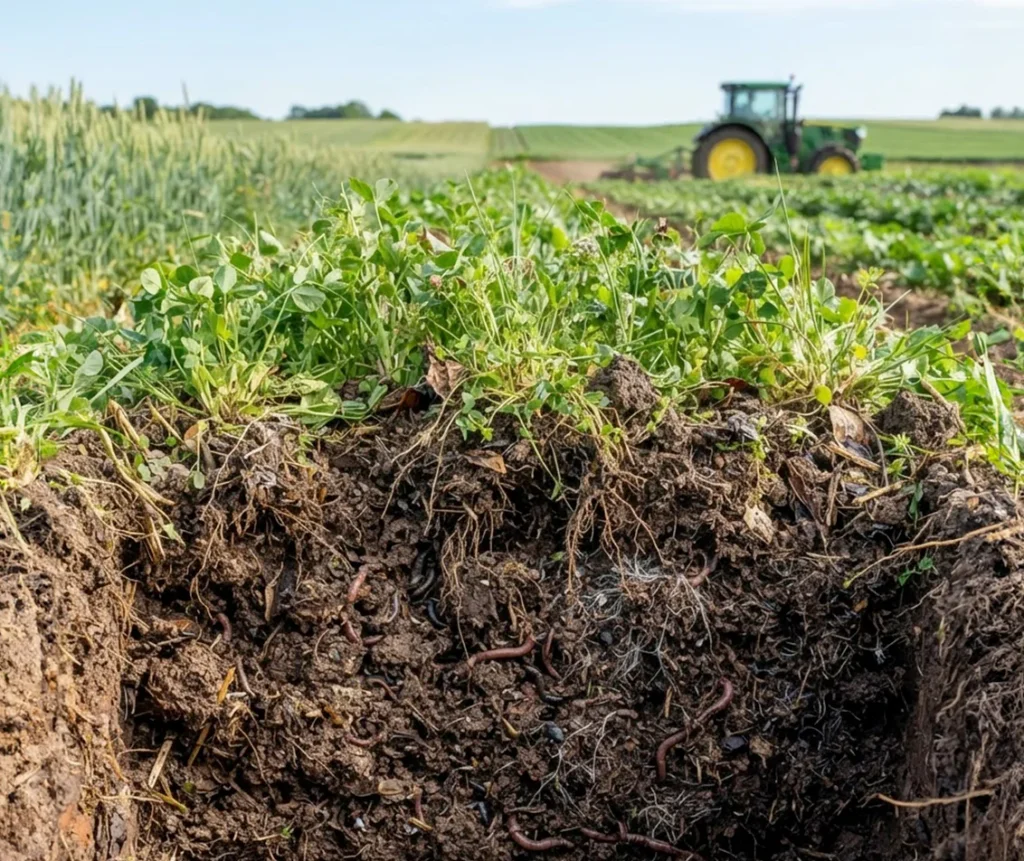
Agricultural biodiversity is not limited to visible wildlife or vegetation along field margins. It also includes microorganisms, fungi, bacteria, insects, earthworms and other organisms involved in processes that are essential to soil functioning.
A diverse biological community may contribute to residue decomposition, nutrient cycling, aggregate formation, the regulation of harmful organisms and the interaction between roots and their surroundings.
Management decisions directly influence these communities. Land use, tillage intensity, rotations, plant cover and organic matter inputs can encourage or limit biodiversity and, with it, certain functions related to productivity and resilience.
Biodiversity above ground is also important. Field margins, hedgerows, cover crops, areas of spontaneous vegetation and other structures can provide shelter and food for pollinators and beneficial fauna.
This does not mean that any increase in vegetation automatically produces a benefit. Management must reflect the crop, climate and specific risks of each plot, including competition for water, the spread of pests or fire risk.
What Benefits Can This Approach Provide?
Regenerative agriculture is associated with several potential benefits, but its results are neither immediate nor uniform.
Improved soil structure
Roots, organic matter and biological activity contribute to the formation and stability of soil aggregates. A suitable structure facilitates air circulation, water infiltration and root development.
Greater capacity to manage water
Well-structured soil can infiltrate and store available water more effectively. This is especially relevant during periods of drought or heavy rainfall, although the outcome will depend on factors such as texture, slope, organic matter and previous management.
More efficient nutrient use
Biological activity contributes to the transformation and availability of certain nutrients. Good soil management can help improve their use, but it does not replace the need to assess the crop’s actual requirements or to plan fertilisation correctly.
Greater crop resilience
Diversifying crops, protecting the soil surface and encouraging an active root system may help the farm respond better to certain stress conditions. Resilience does not mean eliminating risk, but improving the capacity to adapt and recover.
Preserving productive capacity
The ultimate objective is not limited to achieving environmental results. For the model to be sustainable, it must also be agronomically and economically viable. Transition costs, the learning process and the possibility of temporary yield losses are among the barriers identified when attempting to extend these practices on a large scale.
Practices That Can Support Regeneration and Biodiversity
There is no single combination that is suitable for every farm. The most common measures include the following:
Measure Before Acting: The Importance of Soil Analysis
One of the risks associated with regenerative agriculture is adopting practices simply because they are fashionable, without understanding the problem that needs to be addressed.
Before modifying management, it is advisable to establish an initial reference point. Soil analysis helps assess parameters such as pH, conductivity, organic matter, nutrient availability and other relevant indicators.
This information makes it possible to identify limitations, avoid unnecessary interventions and establish coherent objectives.
The initial analysis should be accompanied by monitoring. Changes in the soil usually take place slowly and may vary between different areas of the same plot.
Which Indicators Can Help Assess Progress?
The selection of indicators will depend on the objective and the resources available. Some of the most commonly used are:
- Organic matter content.
- pH and electrical conductivity.
- Nutrient availability and balance.
- Bulk density and compaction.
- Aggregate stability.
- Infiltration capacity.
- Water retention.
- Root depth and distribution.
- Soil cover.
- Presence and diversity of organisms.
- Yield and harvest quality.
- Use of water, fertilisers and other inputs.
It is not necessary to measure everything at the same time. It is preferable to select useful indicators, repeat measurements using a comparable methodology and relate them to the practices implemented.
Digitalisation, sensors and data analysis can facilitate monitoring, but technology does not replace agronomic interpretation. Data are only useful when analysed in the context of the crop, the plot and the weather conditions.
From Pilot Projects to Management Adapted to Each Farm
Regenerative agriculture is expanding, but it still needs to overcome technical, economic and organisational barriers. The lack of common criteria makes results difficult to compare, while initial costs and uncertainty can discourage adoption among farmers.
Progress will require a combination of technical knowledge, appropriate incentives, collaboration between the various actors in the supply chain and measurement systems that do not create a disproportionate burden.
The transition does not necessarily have to take place all at once. It can begin on one plot or with one specific practice, followed by an assessment of the results and an expansion of the measures when sufficient evidence is available.
Regenerative Agriculture Based on Knowledge and Data
Regenerative agriculture and biodiversity provide a framework for reconsidering how soil is managed and how production interacts with the surrounding environment. However, their value will depend on whether they are translated into decisions that are adapted, measurable and compatible with the economic reality of each farm.
Cover crops, rotations, reduced tillage and the conservation of field margins can be useful tools, but they should not be applied automatically. The first step is to understand the soil, identify its limitations and define the results to be achieved.
On the Agrométodos blog, we will continue sharing information on agronomic innovation, soil health and applied sustainability, with the aim of providing the sector with tools that support decision-making based on technical criteria.
Frequently Asked Questions About Regenerative Agriculture
What Is the Difference Between Regenerative and Organic Agriculture?
Organic farming is regulated and requires compliance with specific standards in order to obtain certification. Regenerative agriculture does not have a single regulatory framework and focuses primarily on improving soil and ecosystem functions through practices adapted to each farm.
Which Practices Are Considered Regenerative?
The most common include cover crops, rotations, crop diversification, reduced tillage, field-margin conservation and organic matter management. Their suitability depends on the crop, soil and climate.
Does Regenerative Agriculture Always Improve Productivity?
It cannot be claimed that every practice will always increase yield. Results depend on the initial conditions, management, duration of implementation and suitability of the measures. There may also be costs or temporary production adjustments during the transition.
Why Is Soil Analysis Important Before Changing Management?
Because it provides an understanding of the initial condition, helps identify limitations and supports the selection of the most appropriate practices. Without a baseline, it is difficult to assess whether the measures adopted are producing a genuine improvement.
How Long Does It Take to Observe Changes in the Soil?
It depends on the indicator, soil type, crop and management. Some changes may be detected in the short term, while others, such as changes in organic matter or structure, require continuous monitoring over several growing seasons.